NOTE:As the Sixties continued,
more and more sound-alike
groups were created to try
and capitalize on the Beach
Boys particular brand of
sunny California
hamony. Some groups,
like the Sunrays, were
direct copies of their
predecessors, with none
other than the Beach Boys
disaffected father managing
them! But as the
sixties progressed, groups
synthesized the Beach Boys
original templet, and came
up with entirely new
soundscapes, influenced by
the rapidly expanding drug
culture that had San
Francisco at its core.
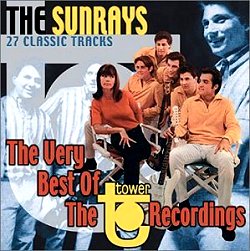
The
Sunrays:
The Very Best Of The
Tower Recordings
Collectables 2731
[CD];
Released November 9,
1999
The
Sunrays are often
overlooked in the Beach
Boys story, but were an
uncomfortable sidenote for
the band and their father
for a time in the
mid-sixties. The group
consisted of
singer/songwriter/drummer
Rick Henn, guitarists
Eddie Medora and Byron
Case and keyboardist Marty
DiGiovanni, all three of
whom previously recorded
as the Snowmen. Added to
their group was bassist
Vince Hozier, and the
group was eventually
signed to Capitol
subsidiary Tower Records
where they
had
a minor hit with "Outta
Gas". But after Murray
Wilson was unceremoniously
dropped from being the
Beach Boys manager, he
turned around and talked
himself into the role of
the
Sunrays manager/producer,
proclaiming that they
would be even bigger than
the Beach Boys (spite is
as good a reason as any to
make music, right?) Of
course, that simply wasn't
going to happen, since The
Sunrays didn't have a
genius songwriter/producer
in the group, and in 1965,
when the group was putting
out its first
surf-inspired feelers, the
trend was on the wane; but
as this generous 27 track
collection proves, Rick
Henn and Co. could fashion
perfectly respectable
music on their own, from
their earliest hot-rod
leanings ("Outta Gas",
"Car Party") to their
biggest hits "I Live For
The Sun" and "Andrea",
which are credible Brian
Wilson wanna-be's; to the
lush "Still" and "Bye
Baby, Bye" and the
rock-a-billy rub of "Hi,
How Are You?" and the
straight ahead rock 'n'
roll of "Loaded With Love"
and "Tears In My Eyes".
The Sunrays even dip their
toes into gritty R&B
on "Since My Findin' You".
But for the most part,
their sound is rooted
somewhere between the pop
of Burt Bacharach and the
beach-party fun of Fabian
- only with rich harmony
backing vocals.
Collectables also tacks on
several bonus tracks of
alternate mixes and
previously unreleased
takes. There is also an
out-of-print comprehensive
3-CD box set of The
Sunrays that Collectables
put out a few years ago
floating around that
collects everything
they ever recorded, but
this single-disc set is
far more palatable for
casual listening.
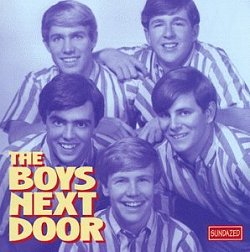
The
Boys Next Door
Sundazed SC 11061
[CD];
Released September 7,
1999
The
Boys
Next Door were true
contemporaries of the
Beach Boys; not only did
they perform around the
same time
(1964-1967), this
Indianpolis group of
friends patterned
their entire sound
and appearance
around their west coast
doppelgangers. But
The Boys Next Door
weren't a simple cover
band, they wrote and
performed their own
material, which payed
obvious homage (and
sometimes outright
theft) to the Beach
Boys' sound. Just
listen to the first cuts
on the disc: "Cold 45,"
"Central High Playmate,"
and most especially
"Mandy" which steals
it's structure directly
from The Beach Boys'
"The Man With All The
Toys!" In fact,
listening to the first
three tracks, you might
be hard-pressed to
distinguish between this
group and Brian Wilson's
songs. But then
this group does a great
thing - by track four
you hear them begin to
develop an individual
sound, which although it
keeps the four-part
harmonies and
songwriting prowess, but
begins to stretch out
past the cars and girls
sensibilities of their
early records.
"One Face In The Crowd,"
"Why Be Proud" and "See
The Way She's Mine" all
have a darker, more
complex mood which fits
the late-sixties
experimentalism that was
becoming more
prevalent. They
still retain their clear
Beach Boys sound - the
thick harmonies, the
high falsetto lead, but
the rhythms become
harder and more complex,
the lyrics become more
introspective, and their
music takes on a
folk-rock edge which is
interesting.
Although The Boys Next
Door never broke into
national recognition,
this CD makes a
compelling argument that
they were worthy of
greater exposure.
1.
Shake
Shake Shake - Tony
Rivers, Stevenson
2. Row Row Row -
Tony Rivers, Vann
3. The Happy Song
- Tony Rivers,
Coakes, Michael
4. I Love the Way
You Walk - Tony
Rivers, Smith
5. I Love You -
Tony Rivers,
Thorpe
6. Life's Too
Short - Tony
Rivers, Bonner
7. Don't You Ever
Tell on Me - Tony
Rivers, Rivers,
Tony
8. She - Tony
Rivers, Jones, P.
9. 'Til We Get
Home - Tony
Rivers, Rivers,
Tony
10. Come Back Baby
- Tony Rivers,
Newell
11. What to Do -
Tony Rivers,
Rivers, Tony
12. Come on and
Love Me Too - Tony
Rivers,
13. Pretend - Tony
Rivers,
14. Nowhere Man -
Tony Rivers,
Lennon, John
15. Baby, What You
Want Me to Do -
Tony Rivers,
Bullock, Aillene
16. The Girl from
New York City -
Tony Rivers,
Wilson, Brian
17. Love You Baby
- Tony Rivers,
18. Girl Don't
Tell Me - Tony
Rivers, Wilson,
Brian
19. Girl from Salt
Lake City - Tony
Rivers, Wilson,
Brian
20. God Only Knows
- Tony Rivers,
Asher, Tony [Rock]
21. Charade - Tony
Rivers, Mancini,
Henry
22. Einer Kleiner
Miser Musik - Tony
Rivers, Rivers,
Tony
23. Graduation Day
- Tony Rivers,
Sherman, Joe
24. Summer
Dreaming - Tony
Rivers, Rivers,
Tony
25. The Grass
(Will Sing for
You) - Tony
Rivers, Brino,
Madame
26. Can't Make It
Without You Baby -
Tony Rivers,
27. Mr. Sun - Tony
Rivers, Rivers
28. For Once in My
Life - Tony Rivers
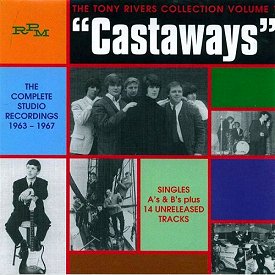
REVIEW:
This album
falls somewhere halfway
between a related artist and
a tribute act, since Tony
Rivers and the Castaways
started out as British
contemporaries of The Beach
Boys, sounding very much
like the Merseybeat acts
they were emulating.
But by the mid-60s,
The Castaways had discovered
the west-coast music of Jan
and Dean and the Beach Boys,
and fall head over heels for
the reverb-drenched guitar
and sweet vocal harmonies of
those groups. By track nine
on this excellent
compilation, the group
morphs into California Ho
dads, and this, years before
The Beach Boys appeal had
crossed over the Atlantic.
And so you have the
hot-rod anthem "'Til We Get
Home" and the harmony tag of
"Come Back Baby" beginning
their love-affair with The
Beach Boys. But the
real copying comes later on,
when Tony Rivers and The
Castaways cover a near
half-dozen Beach Boys songs,
often with stellar results:
"Girl Don't Tell Me" marries
the Beatles-cum-Brian Wilson
song craft with thick,
Spector-like production, and
"Salt Lake City" (titled
here "Girl From Salt Lake
City") is given a faithful,
quicker rendition.
Perhaps most
intriguing is "Einer Kleiner
Miser Musik" which is an
odd, almost "Smile"-like
composition, which is
different than anything else
here. Most
disappointing for me is Tony
Rivers cover of "God Only
Knows" from Pet Sounds,
which unaccountably has a
note change in the melody,
tweaking my ear in an
unpleasant way. The
Castaways also cover "The
Girl From New York City" and
the Four Freshman's
"Graduation Day" making this
disc an interesting look at
how British "Beach Boys"
might sound. Beach
Boys affectiando and author
Kingsley Abbott contributes
excellent liner notes, and
the sound is on par with
other RPM releases, which is
very good.
The
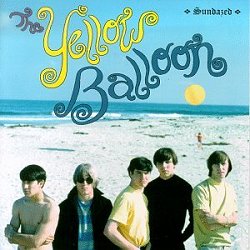
Yellow Balloon
Canterbury CTS-1502
[LP], Sundazed
SC 11069 [CD];
Released 1967, CD
Release February
10, 1998
Sort of a
lighter, wackier
version of the sun
and fun sound that
The Beach Boys
pioneered, The
Yellow Balloon was
sort of a bubble-gum
psychedelia that
could only spring up
during the
late-1960s.
Although the cover
shows a five-man
group hanging around
the beach, The YB
was actually the
creation of
wanna-be-impresario
Gary Zekley, who got
his break in the
music business by
none other than Jan
Berry of Jan &
Dean fame. The
Yellow Balloon sound
is the sort of
simplistic, yet
charming light fluff
you might find on a
Saturday morning
cartoon in the late
'60s, with light,
twinkling numbers
like "Yellow
Balloon," "Pajama
Red" "Good Feelin'
Time" "Follow the
Sunshine," and
"Springtime Girl"
giving you a pretty
good impression of
the tone of the
album. When it
comes to simple
feel-good music, no
one could touch
these guys.
There are occasional
Beach Boys
influences around,
with jumps into
falsetto in the lead
vocal, or amazing
Beach Boys-like
harmonies
(especially on "Good
Feelin' Time") but
mostly it's just
track after track of
sunny summer songs
and good vibrations
in abundance.
Sundazed, one of the
premier independent
release labels out
there has added
seven bonus tracks
of alternate mixes,
additional songs and
the like, but the
last cut is a
hysterical interview
with a
not-too-modest Gary
Zekley. Great
fun for those who
don't take their pop
music too seriously.
Sagittarius:
Present Tense
Columbia 9644 [LP],
Sundazed Music
[CD];
Released 1967, CD
Release October 28, 1997
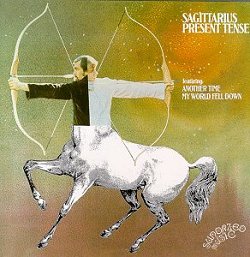
Sagittarius
was
the brain-child of 60's
wunderkinds Gary Usher and
Curt Boettcher.
Although they only
released this one album
under the Sagittarius
moniker (a second album
was released with an
increased presence by Gary
Usher) it was this first
album that captured
perfectly the delicate,
melodic psychedelic pop
perfection that Brian
Wilson was also
experimenting with the
original incarnation of Smile.
Curt
Boettcher had, if
anything, an even purer,
sweeter tenor voice than
Brian, and it saturates
this album with an
etherial mood that I find
very beguiling. The
songs themselves are
beautiful little pop gems
as well, from the catchy
"Another Time" to the
oddly-named-but-beautiful
"Song To The Magic Frog
(Will You Ever Know)"; or
the middle-eastern
influence that dominates
"The Keeper Of The Games"
to the devestatingly
mournful loss of innocence
found in "Musty
Dusty." There's
another Beach Boys
connection here besides
Usher as well - Beach Boy
Bruce Johnston lent his
distinctive vocals to the
one hit single this album
produced: "My World Fell
Down" which is a
tour-de-force of pop
songwriting that featured
practically the entire
"Wrecking Crew" on
backup. Reportedly,
Brian Wilson and Usher
were both knocked out by
Boettcher's voice, and
after one listen to this
remarkable album, I can
see why. I consider
it an almost perfect pop
album.
The
Zombies: Odessey
& Oracle (30th
Anniversary)
Big Beat UK 181
[CD];
Released 1968
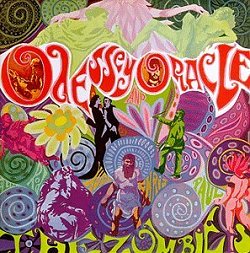
I
discovered this album
when reading the
AllMusic Guide to Rock
years ago and noting
that the authors of
that book strongly
compared the singing
of The Zombies to the
Beach Boys. I
tracked down this
album and was blown
away. Of course,
one listen proved that
The Zombies sound was
nothing like the Beach
Boys' harmonies or
style; it's British
through and through,
yet this album, their
final attempt at
recording together as
a group before
breaking up, is a
slice of pop
experimentalism that
ranks right up there
with Brian's SMiLE!
Colin Blunstone
leads the way with his
etheral, whispery
voice, and the
songwriting, but Rod
Argent and Chris
White, and the
jazz-inflected
instrumentation and
tight, high harmonies
are unlike anything
I'd ever heard
before. This
album spawned the
smash hit single "Time
Of The Season" with
its cool, distant
rhythms, and while
there's nothing else
like that single here,
the rest of the songs
are just as good in
their own way.
From the wrenching
World War One lament
"Butchers Tale" to the
twisted-around
narration of "Care Of
Cell 44" to the
sprightly "I Want Her
She Wants Me" this
album has a poetry and
style about it that
gave me chills the
first time I heard it,
and it's haunted me
ever since. Big
Beat Records has
single-handedly
resurrected the
Zombies catalog on CD,
with fine remastering,
liner notes, and a
plethora of bonus
tracks and new stereo
mixes, and this
classic album (a la' Pet
Sounds) has
both the original mono
and stereo mixes
included on a single
disc, plus bonus
tracks. I love
this album, and
heartily recommend it
to anyone and everyone
who's interested.
Van
Dyke Parks: Song Cycle
Warner Brothers/ADA
25856 [CD]; Released
1968,
CD Release May 18,
1990
1.
Vine Street
2. Palm Desert
3. Widow's
Walk
4. Laurel
Canyon Blvd
5. All Golden
6. Van Dyke
Parks
7. Public
Domain
8. Donovan's
Colours
9. Attic
10. Laurel
Canyon Blvd
11. By the
People
12. Pot Pourri
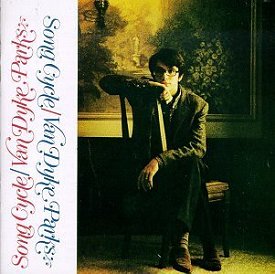
REVIEW: Van
Dyke Parks has long been
known as a respected
composer and arranger,
working in such diverse
fields as soundtracks,
pop, and of course as
lyricist to the Beach Boys
aborted Smile
album in 1966-67. In
fact, in for this latter
event that Van Dyke has
been notorious for his
entire adult life.
But he's also an
extraordinarily diverse
songwriter, and it's on
this, his first album,
that you can hear the full
flower of his explosive
genius. As a
listening experience, Van
Dyke Parks' Song
Cycle is nearly
undefinable, a hazy
collage of influences and
soundscapes tied together
with lyrics that are
easily as trippy as
anything that appeared on
Smile. Comparisons
abound: Gershwin, tin-pan
alley, country-western,
theater music, pop and any
other sound that he
can image make their
way into Song Cycle,
unified by Parks' loopy
lyrics which may include
double-entendres, puns,
allusions, hyperbole, and
sarcasm, sung with his
heavily processed light
tenor voice, which has
always sounded fey, rather
than pop. This is an
album which is more likely
to be admired or studied
than enjoyed, and the
closest parallel I can
give you is to The
Monkees' similarly bizaree
(but much more accessable)
HEAD. But Song
Cycle is achingly
smart; it catered to
Parks' crowd in 1968, the
intellectual avant-garde
who Brian Wilson was
attempting to cater to
with Smile, and
this album, despite its
thick wordplay and manic
shifts in tone and style,
is a fascinating document
of the times, and utterly
unique both in sound and
sensibility - and how many
albums can you say that
about? Parks
revisited this style in
his somewhat more cohesive
albums Discover
America and
The
Clang of the Yankee
Reaper.
Check him out - you might
be surprised just how
diverse and whimiscal his
sound is, and realize
just how much Van
Dyke Parks influenced
Brian Wilson's Smile.
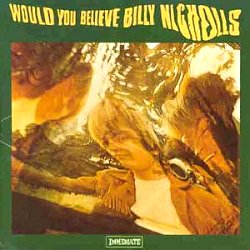
Billy
Nicholls: Would You
Believe
Immediate
NEM
414 [LP], Sequel
414 [CD];
Released 1968,
CD Reissue April
19, 1999
I'd
forgotten
all about Billy
Nicholls' fine album
until a fellow Beach
Boys fan reminded me
of it.
Considered one of the
great "lost" pop
psychedelia albums of
the late Sixties, Would
You Believe has
obvious Beach Boys
influences, not only
with the fine,
shifting musical lines
and high vocals of Mr.
Nicholls, the
album is also drenched
in harmonies and was
produced by Andrew
Oldham, who was a huge
fan of both Phil
Spector and of Pet
Sounds.
But don't listen
expecting to hear west
coast influences here;
Would You Believe
is firmly footed in
England in both
sensibilty and style,
but manages to
sidestep comparisons
with the
Beatles. It's
easy to hear echoes of
Smile on
tracks like "Life Is
Short" and "Come
Again," while songs
like "It Brings Me
Down" and "Life Is
Short" reveal a
bleakness in the
lyrics that is offset
by the almost
relentlessly upbeat
music and cheery
harmonies. The
album is nowhere near
as emotionally complex
as Brian's same work
during this period,
but remains a
compelling listening
experice due to the
fascinating, complex
melodies, occasionally
biting lyrical content
(like the
tongue-in-cheekiness
of "London Social
Degree") and the high
quality of the
production.
Worthy of repeated
listenings.
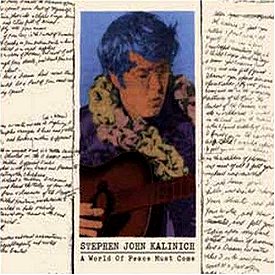
Stephen
John
Kalinich: A World Of
Peace Must Come
Light
In
The Attic 039
[CD],
Released September
23, 2008
Product
Description A World Of
Peace Must Come
was recorded at
Brian's house in
Bel-Air in 1969.
The tapes were
promptly lost, not
to be heard again
until now. For the
first time this
truly timeless
snapshot of an era
and an ethos are
available
nationally. "A
World of Peace
Must Come", an
album recorded by
Brian Wilson in
1969 based on the
poetry of Stephen
John Kalinich,
will finally have
an official
release September
23, 2008. The
album has been
recorded most of
it at Brian
Wilson's house and
in other studios
like Wally Heider
and Sunset Sound.
A World
Of Peace Must
Come will
feature these
tracks: A World Of
Peace Must Come ;
Candy Face Lane ;
I Am Waiting/The
Birth Of God ; The
Deer, The Elk, The
Raven ; The Magic
Hand ; Lonely Man
; Be Still ; Walk
Along With Love ;
A World Of Peace
Must Come ; If You
Knew ; America I
Know You ; A World
Of Peace Must Come
(outro) ; Leaves
Of Grass.
REVIEW:
When I
mentioned on this site's
message board that I was
going to be including this
album in the site reviews,
one fan asked me why?
Well, for a couple of
reasons: first of all,
Stephen John Kalinich was an
inside member of the Beach
Boys circle in the late 60s,
writing songs with Dennis,
Brian and others; and this
particular album was
recorded at Brian's house
during that period. In
fact, it was long rumored
that Brian had provided
music and vocals for the
album, which is, literally,
true. In fact, Light
In The Attic Records, which
has released this
long-thought-lost album,
lists Brian Wilson as
co-producer, and the lengthy
liner notes state that Brian
wrote music for five of the
album's 13 tracks. He
also plays organ, and
provides vocals for "Lonely
Man" (more about that
later). So, from a
cursory glance at the
credits, you might think
that this album contains
some lost songs of Brian
Wilson; but sadly, that's
not the case. This is
in every way a poetry album,
with a smattering of songs
in the mix, but the songs
are all by Stephen Kalinich,
and the music that Brian
provides for the other
tracks are simply ambient
sounds; subtle and
unintrusive. For
example, the track "Be
Still" (not the Beach Boys
song) says that music
is by Brian Wilson, and that
he plays the organ.
Yes, but it's not a
song - it's just Brian
noodling in the background
while Stephen reads his poem
- some vaguely church-like
chords that fill in the
space and create a reverent
atmosphere. On "The
Magic Hand" Brian (as well
as Marilyn Wilson his wife)
are credited with background
vocals, but that entails
Brian wailing like a
incoherent siren, while
Marilyn (and unnamed
friends) chanting out some
sloppy, sing-song melody
towards the end of the
piece. As for the
poems themselves?
Well, they're
certainly performed with
great earnestness, with lots
of simplistic rhymes and
idealistic imagery which
speaks more about the times
than about Stephen's talent,
which has grown more mature
than what you'll hear on
this album. And as far
as Stephen's songwriting
here -- well, there's a
reason he's a poet, not a
musicmaker. There's
some token curiosity to
hearing A World Of
Peace Must Come,
since you get a (very) small
idea about what Brian was
doing during his "lost
years" - but the pleasures
are thin indeed.
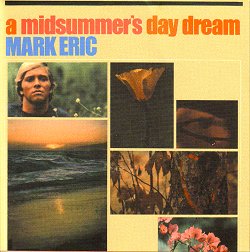
Mark
Eric
(Malmborg): A
Midsummer's Day
Dream Revue
7210
[LP], Rev-Ola
CR-REV
18 [CD];
Released 1969, CD
Release December
10, 2002
I
was recommended this
CD by another Beach
Boys fan who felt it
would fit nicely on
this page.
Originally released
in 1969, the album
was a huge flop, but
has since gained a
reputation as being
a "lost
classic." I've
gained a healthy
cynicism for
anything labelled a
"lost classic,"
since most albums
with that moniker
deserve to stay
lost, but this album
has a definite
charm, and it also
carries some
markedly Brian
Wilson-ish/Burt
Bacharach
sensibilities.
Written and sung by
Mark Eric, the album
is a dreamy paean to
California and
romance, with a
sweet wistfulness in
the lyrics and
melodies that harken
back to the sweeter
moments on the Beach
Boys Today!
and Pet Sounds
albums. To my
ears, it's a little
too sweet, and
certainly would have
been out of step in
the turbulent era of
the late 1960s, with
songs like "Where Do
The Girls Of Summer
Go" and "California
Home" all evoking a
rosy nostalgia for
the innocence of
past times.
But there are a
bunch of good songs
here, from the
upbeat "I'd Like To
Talk To You" to the
melancholic "Sad Is
The Way I Feel" and
the fantastic "Take
Me With You" (which
would fit perfectly
on Pet
Sounds). Other
songs lean towards a
too-slick sound that
would be prevalent
in the Seventies,
like the
almost-disco of
"Night Of The Lions"
or the shovelled-on
sentimentality of
"Lynn's Baby."
I'm also not sold on
Mark Eric's voice,
which is
multi-tracked
thorughout,
and a little
whiny for my tastes,
but on repeated
listenings, this
album's definitely
growing on me.
Rev-Ola has stuffed
the CD with seven
bonus tracks from
several subsequent
singles and
alternate 45 mono
mixes.
1.
See the Light
3:06
2. Make It
Easy 3:06
3. Hey Lord
3:49
4. Lady 3:28
5. Don't
Worry, Bill
3:17
6. Get Your
Mind Made Up
4:10
7. Highs and
Lows 4:49
8. I'm So
Happy 3:17
9. Dove 2:18
10. Another
Day Like
Heaven 5:42
11. See the
Light
(Reprise) 1:28
All songs
written by
Blondie
Chaplin and
Ricky Fataar
REVIEW:
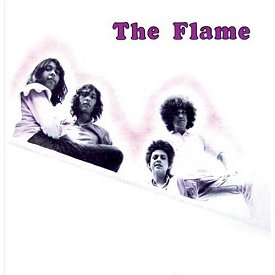
This album, produced
by Carl Wilson and
engineered by Steve
Desper, was a direct
result of the
acclaimed South
African band being
spotted in a London
nightclub by Al
Jardine, who mentioned
them to Carl, and who
subsequently signed
them to The Beach
Boys' fledgling
Brother label.
Released in 1970, the
album flopped, despite
a minor hit single
("See The Light/Better
Get Your Mind Made Up"
- #95). After
the failure of the
album, the band broke
up, and two of the
members, Blondie
Chaplin and Ricky
Fataar went on to
serve as supporting
players, then active
contributors to The
Beach Boys in the
early part of the
1970s. The album's
first three songs are
strongly reminiscent
of the songs which
transformed the sound
of the Beach Boys on
their albums Carl
&
The Passions: So
Tough and
Holland,
with a rough-and-ready
R & B hybrid with
touches of psychedelia
thrown in. In
fact, after beginnning
this album, I think
it's impossible to
understate just how
much The Flame's
influence permeated
The Beach Boys own
sound between
1972-1974; it's
obvious that The Beach
Boys ingested the vibe
of The Flames almost
whole. And
although the sound is
more akin to a
free-form jam at
times, there are also
indefinable blendings,
like the
Beatle-esque/Southern-comfort
swinger "Lady" or the
similarly
John-Lennon-ish
composition "Don't
Worry Bill" (which
would later be played
at Beach Boys concerts
during the
Chaplin/Fataar
era). "Better
Get Your Mind Made Up"
is also memorable,
sounding not unlike a
White
Album
outtake. In
fact, it's pretty
apparent that The
Beatles influence is
heavy throughout the
album, with songs like
the haunting "Highs
And Lows" and the
similar "Dove" both
sounding a bit
like McCartney
throwaways, but
blended with The
Flames own peculiar
brand of South
African high-octane
fuel. The jumpy
"I'm So Happy" is a
perfect example, with
it's gospel-revival
vibe skewed with a
world-music drone that
sets it apart from
typical American rock
music, and "Another
Day Like Heaven"
sounding like The
Beatles' "A Day In The
Life" turned on its
head. A great
lost slice of late-60s
psychedelic pop -
worth checking out.
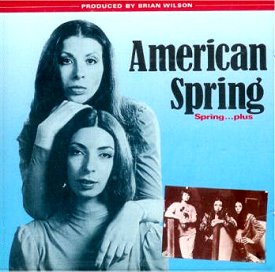
American
Spring: Spring
...plus
United
Artists 5577 [LP],
Released 1972;
Rhino R21S-75762 [CD],
Released 1989;
See For Miles SEE CD
269 [IMPORT CD],
Released December 16,
1994
1.
Tennessee
Waltz [King,
Stewart]
2. Thinkin'
'Bout You Baby
[Love, Wilson]
3. Mama Said
[Denson,
Dixon]
4. Superstar
[Bramlett,
Russell]
5. Awake
[Tucker]
6. Sweet
Mountain
[Sandler,
Wilson]
7. Everybody
[Roe]
8. This Whole
World [Wilson]
9. Forever
[Jakobsen,
Wilson]
10. Good Time
[Jardine,
Wilson]
11. Now That
Everything's
Been Said
[King, Stern]
12. Down Home
[Goffin, King]
13. Shyin'
Away [Rovell,
Sandler,
Wilson]
14. Fallin' in
Love [Wilson]
15. It's Like
Heaven
[Rovell,
Wilson]
16. Had to
Phone Ya
[Rovell,
Wilson]
REVIEW: American
Spring,
an offshoot of failed
1960s girl group The
Honeys, was
formed by two of the
three members of that
group:Diane and
Marilyn Rovell (aka
Mrs. Brian
Wilson). The
original album Spring,
was released in 1972,
and has a lot of
interest for fans of
the Beach Boys, since
not only was it
co-produced by Brian
Wilson (along with
David Sandler and
engineer Stephen
Desper), and contains
several covers of
songs the Beach Boys
(including "Thinkin'
'Bout you Baby" (aka
"Darlin'"), "This
Whole World,"
"Forever," "Good Time"
and "Had To Phone
Ya"), plus it features
several of the Beach
Boys on backing
vocals, with Carl,
Mike and Brian's voice
prominantly displayed
at regular
intervals. But
for all that, the
album feels
under-done, and
despite the best
efforts of all the
talent involved, is
flat. Most of
the blame lies with
the Rovell sisters,
who, without lead
voice Ginger Blake
(who had broken away
to pursue a solo
career), is left to
their own shallow
voices, which really
only worked when
couched in the thick,
wall-of-sound
production values that
Brian brought to their
best efforts as the
Honeys. Here
though, their voices
sound thin and
unremarkable, much
like two housewives
singing in the kitchen
- there's not a lot of
natural talent in
either of their
voices, and with the
production similarly
lacking in the
richness that would
support them.
Particularly painful
is the cover of The
Carpenter's
"Superstar" which is
hammered to death by
their wooden, bland
singing. Also
hampering the album
are the tempos, all of
which seem
deliberately slow,
turning sparkly songs
like The
Shirelles'
"Mama Said" into
half-hearted exercises
in
redundancy.
But for fanatics,
here's where you'll
find the only version
of the Brian
Wilson/David Sandler
song "Sweet Mountain"
which, with its
druggy, psychedelic
feel, sounds like a
refugee off of The
Beach Boys' Smiley
Smile.
The best moments are
the ones which take
some chances: the
R&B swing of
"Everybody" or the
interesting remake of
"This Whole World"
which transforms the
song into a country
swinger. Also
nice is "Down Home"
which is one of Carol
King's better
compositions.
But I'll take Dennis's
original take of
"Forever" over the
version here, and
"Good Time" merely
tracks the girl's
voices over the
original backing
track, and their lyric
changes sound
creepy. Overall,
this is a quirky,
uncomfortable album
which will appeal to
Beach Boys'
collectors, but few
others. Out of
print and very hard to
find.
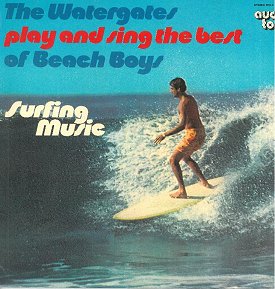
The
Watergates: Play and
Sing the Best of Beach
Boys
Auditon
909-2-121101 [LP]
Released 1973
Side
A
1. Surfing Music
2:37
2. I'm Looking Over
My Shoulder 2:32
3. High School
Leaver 2:23
4. Let's Talk 3:09
5. In a Whirl 3:20
6. Sloop John B.
2:47
Side B
1. Hot-Rod 2:56
2. People Tell Me
2:36
3. I'm Not Going to
Camp This Year 2:15
4. Surfing '73 4:10
5. Lazy Day 2:10
6. Show Me the Way
to California 3:13 Total
length: 34:08
REVIEW:
This
is one of those releases
which is shrouded in
mystery - a German-pressed
album, released in 1973,
under the moniker of "The
Watergates" (get it?) -
the cover would make you
think that this album is
replete with covers
of Beach Boys hits,
when in reality, it's
almost entirely original
compositions, written (and
performed?) by John
O'Brien-Docker, an
Irishman living in Germany
at the time. It's
mostly slick pop, highly
reminiscent of the lesser
stuff Ron Dante of The
Archies was putting out at
the time. John
O'Brien-Docker possesses a
pleasant, slightly nasal
tenor voice, and the
themes of the music, from
"High School Leaver" to
"I'm Not Goin' To Camp
This Year" to "Lazy Day"
all point to a slacker
mentality which alternates
with California-leaning
titles such as "Surfing
Music" "Hot-Rod" "Surfing
'73" and "Show Me The Way
To California".
Although the songs are
vaguely similar to Beach
Boys style, and there is a
lot of harmonic
overdubbing present -
nothing here really sticks
in your mind - this is
classic AM radio fodder;
any of the melodies could
have easily been converted
to a hamburger jingle, and
have as much impact.
Notable only for its
rarity, this one is a
pleasant, forgettable way
to kill a half-hour of
your time.
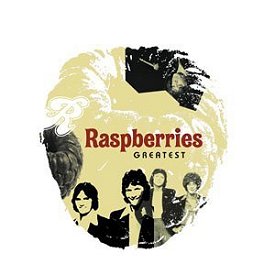
Raspberries: Greatest
Captiol
[CD];
Released May
24, 2005
1. Go All
The Way
2. Come Around And
See Me
3. Don't Want To
Say Goodbye
4. I Saw The Light
5. I Can Remember
6. I Wanna Be With
You
7. Drivin' Around
8. Let's Pretend
9. I Reach For The
Light
10. Nobody Knows
11. If You Change
Your Mind
12. Tonight
13. I'm A Rocker
14. Ecstasy
15. Last Dance
16. I Don't Know
What I Want
17. Cruisin' Music
18. Starting Over
19. Party's Over
20. Overnight
Sensation (Hit
Record)
REVIEW: The
Raspberries
were one of the premier
power-pop bands of the
Seventies, and owed much
of their style and
success to the Beatles,
and ordinarily a band
like this wouldn't show
up here but for one
undeniable fact: their
leader, Eric Carmen is a
huge Beach Boys fan, and
not only that, he has an
incredible knack for
writing uncanny
pastiches that mimic
classic Brian Wilson
songs. Listen to the two
examples on this
collection: "Driving
Around" and "Cruisin'
Music" - you'll have to
agree that he's captured
something of the classic
vibe that Mike Love
continues to preach
today. And not only
that, but after the
Raspberries broke up, Eric Carmen continued to write amazing
pop ditties that echo
the California sound:
check out his solo
works like "She
Did It" and "Top Down
Summer;" the melancholy
mood that drenches
"Boats Against The
Current" or even the
acapella harmony lead-in
on "Hey Deanie" or "Make
Me Lose Control" and
you'll hear Brian
Wilson's stylistic
fingerprints all over
them. Eric doesn't
simply write Beach Boys
pastiches because he
can, he writes them
because he loves the
music, and it shows.
While the over-the-top
bombast or unabashed
romanticism of their
other works might not
appeal to all Beach Boys
fans, but for a quick
flash-back to the
endless days of Summer,
you could do worse than
popping some Raspberries
or Eric Carmen into your
music player.
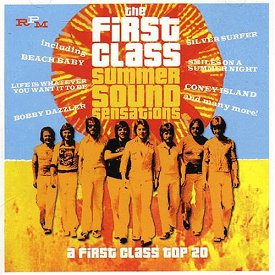
The
First
Class: Summer Sound
Sensations - A First
Class Top 20 RPM
Records UK
[CD]; Released
August 23, 2005
I
know countless casual
Beach Boys fans who
have asked repeatedly
which album the song
"Beach Baby" is
on.
For those
uninformed, it's
here. That paean
to the summer of 1974
was sung not by the
Beach Boys, not even
by native
Californians, but by a
group of British
studio musicians and
singers who managed to
capture something of
the Beach Boys' vibe
in that impossibly
catchy single.
Call it a guilty
pleasure, but "Beach
Baby" is a great
sing-a-long
song. The single
can be credited to
songwriter John
Carter, who enlisted
singer Tony Burrows
and several other
musicians to cut the
track. Once it
became a hit, Carter,
Burrows, and group
quickly recorded
several other songs to
try and capture
lightning in a bottle
again, and released
these songs under the
name "The First
Class." This CD
collects these
recordings and others
by the group into what
I consider to be one
of the hidden shames
of my CD collection,
but which I'll throw
into my player now and
again to enjoy.
Other songs which I
enjoy are: "Old Time
Love," "Smiles On A
Summer Night," "Life
Is Whatever You Want
It To Be," and
"Seven-Ten To
Nowhere." Also
on this album are such
'70s throwaways as
"The Disco Kid,"
"Surfer Queen" and
"Bobby Dazzler" - so
you've been warned; if
you don't mind hiding
this particular title
when your friends come
over for dinner, you
might just find
yourself slipping it
into your CD player
(after you've shooed
away the guests and
shut the blinds.)