NOTE:
Here are the books that for
one reason or another,
create their own niche in
the Beach Boys canon.
For this reason, they can go
either way on the taste
scale. But for
whatever reason, they stand
alone, and fans need to
tread carefully.
Hopefully this guide will be
helpful to you in making
your own choices. These
reviews are solely my own
opinion.The
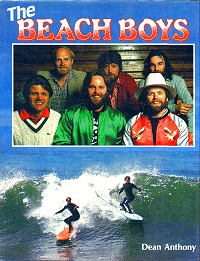
Beach BoysDean
Anthony, 1985; Crescent
Books, 64 p.
(out
of five)
"In 1965
pop had reached a
watershed. If the last
two years had seen the
emergence of the beat
group - simple,
effervescent and fun -
the next two years
were going to be an
altogether artier
affair. Everything was
getting just a bit
more serious. Suddenly
Lennon and McCartney
were classic
composers, Bob Dylan
was a poet and the
Rolling Stones were
the precursors of new
attitudes among the
young. . . This was
pop exploring new
ground and Brian
Wilson wanted to take
the Beach Boys there.
He became obsessed,
watched their every
move and craved the
critical plaudits they
were afforded."
[pg. 30]
I recall
passing this book up a
couple of years ago,
and now, having
finally bought it, I
remember why. With
next-to-nothing in the
way of text, I can't
call this a
'biography'. Mr.
Anthony has done
nothing more than
compile a photo album
(mostly from the
mid-to-late
seventies), slap
together a few
off-the-cuff
biographical
paragraphs, and call
it a book. Some of the
pictures are
completely off the
subject. . . a full
page of Ringo Starr?
Or Hank Williams Jr.?
Or how about some
ridiculously pointless
shots of the audience?
Oooo. . . be still my
beating heart. There
are a couple of good
photos of the band,
but nothing special,
and the text is only
there so Mr. Anthony
could take credit as
"author." A low-grade
entry in the Beach
Boys' canon.
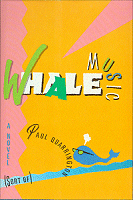
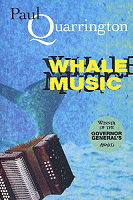
Whale Music
Paul
Quarrington,
1990; Doubleday,
228 p.
"When the music ends I brace
myself.
"All right,
Sal," I sigh
wearily.
He is head A and
R man at Galaxy,
how could I have
forgotten that,
he is the Joseph
Goebbels of
popular
music. He
will tell me how
wonderful this
music is, then
he will evoke
the name of the
great god
Mammon, he will
speak of
demographics and
marketing
stratagems, if
you don't want
to hang around
to hear it, I
can certainly
sympathize. First
of all, though,
like any good
record
executive, he
has to pull at
his chin and
pretend to be
deep in thought. "It's
even better than
I thought it
would be," Sal
announces, a
novel prelude,
not that I'm
fooled. .
. ."But,"
I remind him. "But?" "But
it's not
commercial, but
the kids won't
like it, but
it won't get air
play, but
record stores
wouldn't stock
it if it came
with a free gram
of
cocaine." [pg. 135]
A
really odd
book. In
what may be the
first of its
kind, here we
have a
fictionalized
account of the
Beach
Boys!
Essentially a
barely-concealed
retelling of the
life of Brian
Wilson (now
named Desmond
Howl) and the
life and death
of Dennis Wilson
(renamed Danny
here). Mr.
Quarrington's
sole claim to
artistic merit
is in attempting
to portray
Brian's thoughts
during his
reclusive
1973-1983 years,
with the
character
Desmond trying
desperately to
complete his
masterpiece
"Whale Music"
(read
"Smile").
All the while
acting eccentric
and neurotic yet
strangely in
tune with
everyone around
him. It's
an intriguing
idea: trying to
get into the
head of one of
rock music's
greatest
enigmas, but
while reading
it, I felt that
the author was
over-analytical
and too clever
by half by using
obscure literary
references,
throwing in
"alternate
reality" lyrics
which are
occasionally
funny but mostly
dumb, or simply
trying to
titilate the
reader with an
almost endless
amount of
graphic sexual
references, all
of which are
crude and
debasing
(including a
scene during a
concert when the
lead character
gets turned on
by watching his
mother.) I
spent most of my
time while
reading it
trying to figure
out who the
author was
referencing with
his pseudonyms,
rather than
being pulled in
by the
story.
What disturbed
me the most is
how vapid the
characters are,
and how, at the
end of the book,
when the author
attempts to
create a
cathartic state
of grace for
Desmond at the
unveiling of his
masterpiece, it
feels
empty. But
the entire novel
feels false: an
overthought
retelling of
what most fans
already
know.
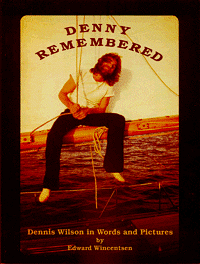
Denny
Remembered: Dennis
Wilson in Words and
Pictures Edward
Wincentsen, 1991; Vergin
Press, 197 p.
My father once
told me that love could
not be begged, borrowed
or stolen. Only
given. I may not
have been able to spend
as much time with my
father as I would have
liked to, but the time
that I did spend with
him was the most valued
a child could
have. He was very
special to me ... as I
know I was to him. . . I
respected my father with
all my heart and
soul. I watched as
he constantly gave away
all that he had to
others, asking nothing
in return but the
satisfaction they
received from what he
gave them. I only
wish I could have spent
more time with
him. To tell him
how very much I loved
him. I know that
my Dad is at peace now,
and that puts my mind at
ease. I love you
Dad. [tribute from
Jennifer Beth Wilson, pg
107]
A tender and
touching tribute to the
late Dennis Wilson,
"Denny Remembered" is a
fond, funny, touching
and intimate portrait of
the quintessential Beach
Boy. Actually
little more than a fan
magazine expanded to
book size, Mr.
Wincentsen has pulled
together dozens of black
and white photos of
Dennis, along with
numerous writings from
fans and writers such as
Domenic Priore, Fred
Vail, and David
Leaf. Also
included are song lyrics
(from Lindsay Buckingham
and Christine McVie),
poems and stories
written by fans,
reminiscing from the
author, and most
touching: written
tributes from five of
Dennis's six children
(Gage being only one
year old when his father
died.) A tribute
like this can be syrupy
and overdone, but Mr.
Wincentsen has done a
very tasteful, stylish
job of gathering
together pieces from
many different sources
and presenting them
here.
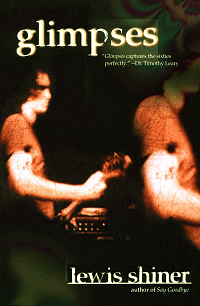
Glimpses: A
Novel Lewis
Shiner, 1993;
William Morrow
& Co., 331
p.
"It
took Brian six
days to finish
Smile, like
Jehovah in the
Old Testament.
I watched it
come together
and I saw why
nobody else
could have
reconstructed it
from the tapes
in the
vaults. It
was like the
Tommy Tedesco
guitar
part.
Nobody but Brian
knew what the
missing pieces
were, and the
missing pieces
changed
everything. . . .
"Capitol's not
going to like
it," Anderele
said. "Here's
what
you say," I told
him. "You
say, 'You guys
may not sell a
million units of
this
today. But
you will
eventually.
You'll still be
selling copies
of this record
in twenty
years.'
Then you should
have Derek
Taylor give an
acetate to the
Beatles.
McCartney
especially.
Maybe he'll give
you a quote you
can use in
publicity." "A
quote?" Anderele
said.
"Like on a book
cover or
something?" "Why
not? You
have to market
this as a work
of genius, not a
piece of
disposable
pop." I
was wired,
ecstatic.
It was so close. "It
could work,"
Anderele
said. "It
might actually
work." Brian
came out a half
an hour
later. He
was
smiling."
[pg. 140]
Here's
the ultimate
conceit of a
Beach Boys
fanatic:
imagine that
you're a loser
stereo repairman
who suddenly
discovers that
you have the
power to conjur
up lost music
from the heyday
of the 1960s and
capture it on
tape. Not only
that, but you
can transport
yourself into
the past and
mingle with
real-life
characters like
Jim Morrison,
The Beatles,
Brian Wilson,
and Jimi
Hendrix, and
influence their
lives to a
degree.
What do you
do? Why,
if you're
fictional fanboy
Ray Shackleford,
you "Get Back"
and make right
all of the
tragic wrongs of
the time.
No, I'm not
talking about
saving President
Kennedy or
Martin Luther
King -- Lewis
Shiner knows
what the public
really needs:
more great
music! In
the case of the
Beach Boys, the
choice is
obvious: link up
with Brian
Wilson and get
him to complete
"Smile." A
fantastical
puree' of "What
If" combined
with omniscient
20/20 hindsight
sets the tone
for this
off-kilter fable
of a perfect
world.
Well-written,
with just enough
chutzpah to pull
it off, I have
to admit that as
a read,
"Glimpses" is a
guilty pleasure,
and Lewis Shiner
manages to make
the reader
suspend
disbelief for
long enough to
get the story
told. On
the down side,
there's really
not a lot of
character
development on
the part of
these famous 60s
icons; just a
brief skim off
the top; and the
author tends to
make it all a
little too easy
for Ray
Shackleford: he
can shove aside
Mike Love, worm
his way into
Brian's inner
circle and talk
Brian into
saving "Smile"
in less that a
chapter.
Now don't you
wish it really
had been that
easy?
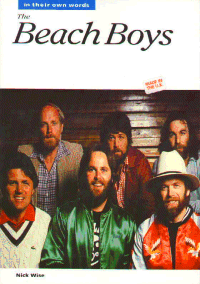
The
Beach Boys: In Their Own
WordsNick
Wise, 1994; Omnibus
Press, 112 p.
"Few groups
in the history of rock
have washed their dirty
laundry in public as
enthusiastically as The
Beach Boys. If
Mike wasn't criticising
Brian and Dennis for
their errant ways, then
Dennis was telling Mike
to go take a hike, and
while Brian was up to
his neck in sand and
dope, Carl was simply
wishing everyone would
stop bickering and get
on with it, while poor
little Al just shrugged
his shoulders and shut
up like he was
told. And along
came Bruce who took his
cue and waded in like
the best of them."
[pg. 5]
Now here's a
book for the nineties: a
sound bite package of
odds and ends quotations
by the Beach Boys,
perfect for any
occasion. Need a
quick stab of authority
for the newsgroup?
Here's Mike, telling
Brian not to "f*** with
the formula."
Granted, there's no
reference as to exactly
when he said it, or who
heard him say it, but
it's there. In
fact, the biggest flaw
in this book is that
while the quotes are
interesting in their
way, there's no
documentation as to when
or where the quote was
made. Was it for
an interview?
Reported by a close
friend? Was it
said at all? Who
knows? But it's in
print now, and so it
must be true!
Divided into chapters by
subject, we get quick
bits of "The Early
Days," "The Records,"
"Surf Music and it's
image," "Good
Vibrations," "Bad
Vibrations," yadda,
yadda, yadda and all the
rest. An
enjoyable, quick
read. Check your
brain at the door.
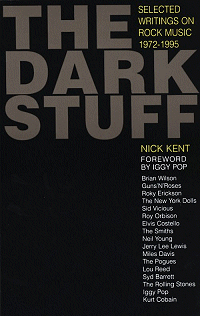
The Dark
Stuff: Selected Writings
on Rock Music 1972-1995
Nick
Kent, 1995; DaCapo
Press, 379 p.
"The king of
California, with madness
in his eyes and vomit on
his 'jammies': it was
the Citizen Kane of all
great rocky-horror
stories, but for me it
was more personal. I
remember being thirteen
or fourteen years old
and to escape from the
ravages of adolescence
I'd go into record shops
to study Beach Boys
album covers for what
seemed like hours on
end. . . . 'Fun' wasn't
a concept I was too
personally attuned to at
this point in my life
and I can't begin to
tell you how exciting it
felt to stand there
holding photographic
proof that it actually
existed somewhere -
albeit thousands of
miles away from the
land-locked dumps I
found myself
inhabiting." [pg.
4]
Nick Kent is
one of those authors who
likes to spew his
opinions all over the
page. "The Dark
Stuff," which is a good
description not only of
the grim subject matter
the author tackles but
the psychology of the
writer as he bends light
away from the reader in
this relentlessly
downputting book.
Filled with biting
description and loads
of profanity, Nick Kent
not only writes about
the dessicated lives of
rock stars, he
successfully pulls the
reader in to experience
those lives themselves
-- making this very
visceral reading -- not
always a good
thing. The book
begins with a long
chapter on Brian Wilson
from when the author
first met him in the
mid-seventies. He
discusses when Paul
McCartney came to visit,
and his editor's rabid
dismissal of Wilson as a
vital musical force --
but the author also
tries to hash out in the
limited amount of space
a biography of Wilson,
his torrential
relationship with his
father Murray, the
sometimes acrimonious
relationship between him
and the Beach Boys, and
his downward spiral into
drug abuse and
near-total
seclusion. It's
riveting writing, but
it's also a real downer,
and for that reason it
recieves only a
qualified
recommendation.
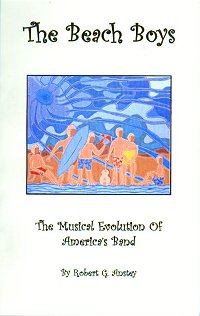
The Beach
Boys:
The Musical
Evolution Of America's
Band Robert
G. Anstey, 2004; West
Coast Paradise
Publishing, 160 p.
"Anyone who
has bootlegs from the Smile
sessions knows that
there was some real
magic there and that
Brian really had
something going.
It was a special time
and he was a special
genius who knew what he
was doing. Yes,
his vision got shaken up
at the end of the
sessions and he lost his
focus a bit but when he
was in control of
things, the music was
out of this world.
The Beach Boys versions
of those songs from the
Smile sessions on
the Smiley Smile
album are
very disappointing
and even they knew that
they had fallen short on
the project." [pg.
72]
If notorious
filmmaker Ed
Wood had been a
huge Beach Boys fan, and
instead of making
atrocious movies
had written all his
musings on bits of
notepaper and then
published them, this
book would be the
result. Canadian
Robert G. Anstey,
a self-made author,
editor, and songwriter
of several hundred
pieces, has published
this tribute to
America's Band, and done
nobody a service in the
process.
Disjointed, repetitive
in the extreme, and
written without a
hint of style or
insight, this book
needed some serious
reshaping and editing
before seeing the
light of
day. Filled
with mundane, vague
statements, conjecture,
and glaring mistakes,
I was shocked that
this author, a reputed
editor/publisher of a
poetry and prose
magazine, repeatedly
uses blatant
cliches, bland
description,
and pitiable rhymes
throughout (he includes
lyrics to a few of his
"Beach Boys" songs in
the index - here's
a sample):
"They sang
about beaches and
surfing
and cars and girls too
they toured all over
the USA
they were sure a
good-looking crew" ["Back To
Basics" pg. 150]
Bob Dylan he's
not. What's most
puzzling about this book
is that for a reputed
author of more than 125
books (including
over fifty-three
volumes of his song
lyrics!!), is how little
continuity and flow
there is between
chapters; it just
rambles from subject to
subject, covering
biographical
information, album
reviews, historical
exposition and whatever
else happens to cross
the author's mind.
Anstey states in
the foreword that the
book grew out of a
series of articles he's
written over the years,
and apologizes
beforehand that
there might be some
repetition - all
well and good, but it
reads like a series of
sticky notes that have
been thrown together in
the most haphazard
fashion, and it
becomes evident early on
that Mr. Anstey has no
insider knowledge of
what he's writing, that
his "facts" are
sometimes completely
false (he claims early
on that Dennis "fell
off" his
boat "The Harmony"
when he
drowned), and all
that the readers are
getting are his personal
musings on his favorite
band. If Mr.
Anstey wrote with even a
smidgen of humor, talent
or style, I could
recommend this book on
those merits, but this
is the blandest, most
superficial treatise on
the Beach Boys that I've
ever had the misfortune
to read. Of
cursory interest only,
and only
available for
purchase from the author.
The
Beach Boys: Pet
Sounds Jim
Fusilli, 2005; Continuum
International Publishing
Group, 121 p.
[Pet
Sounds] really is a
gift to those of us who
need it. It so
perfectly captures a
perspective that isn't
part of the daily
discussion. I
mean, people don't go
around telling each
other how alienated they
feel, and how divorced
they feel from the
emotions others so
readily access, and how
they desperately want
love and acceptance and
yet fear what may come
if they grow accustomed
to them and then these
vital elements of life
suddenly go away.
If someone does talk
about these things, it's
rarely with such
eloquence and
clarity. With
Pet Sounds, we hear
what Brian thought and
felt, and his thoughts
and feelings are
communicated not only
through lyrics, but also
through often
disorienting music that
wheedles its way
into our subconscious.
[pg.
117]
When
I
heard that another book
about Pet Sounds
was coming out, I have to
admit that I gave a small
inward groan. After
all, we already have two
fine books covering the
same ground, and there
have been literally
hundreds of smaller essays
and articles written; what
could another add to the
mountain of published
literature?
Thankfully, author Jim
Fusilli is no
slouch. Music
reporter for the Wall
Street Journal and
continuing contributer to
National Public Radio's
"All Things Considered,"
Fusilli is a keen observer
and eloquent writer,
bringing a fresh
perspective to this
seminal album with wit and
pathos. He starts by
talking about the forces
that shaped his own
childhood, notably Walt
Disney - from watching
Walt host his weekly show
on TV, and
from viewing endless
films and TV shows, Mr.
Fusilli had a utopian
vision of California
imprinted on his
mind. I laughed out
loud when I read a
description of Annette
Funicello as "an Italian
sparkplug." But this
autobiographical
introduction to the book
works perfectly,
humanizing the author to
his audience, and letting
us know exactly where he's
coming from. And
despite the slimness of
the book, Fusilli doesn't
simply dive into analyzing
the album, (he doesn't
really dig in until
page 41) he unfolds, in a
very gentle way, the
history of the Beach Boys
in both professional and a
deeply intimate
portrait. Mr.
Fusilli knows of what he
writes as
well, infusing his
song-by-song examinations
with his clear, intuitive
understanding of the what
makes each
song tick. He's
even lightly critical of
several
numbers, which I
frankly admire, having
read several like-minded
articles that place Pet
Sounds on an
unattainable
pedestal. I felt as I
was reading this that I at
last understood how Pet
Sounds came about;
the shadowy psyche of
Brian Wilson became a
little clearer, reflected
in the dark mirror of his
art and here illuminated
for my eyes. The
songs are examined one by
one, with pertinent quotes
from most of the major
players, from Marilyn
Wilson to Brian himself,
with several small
facts thrown in that I
hadn't recalled reading
anywhere else. This
book, part of a series of
acclaimed books about
individual albums, is
published by Continuum
Books, and is a fine
addition to your Beach
Boys library.
I unreservedly
recommend it.
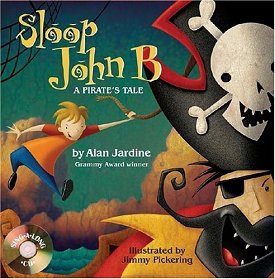
Sloop John B: A
Pirates Tale (May 1, 2005)
Text by Al
Jardine, Illustrated by
Jimmy Pickering; Milk
& Cookies, 32 p.
"We
sailed into a
fog,
according to
the captain's
log.
That's when
the pirate
ship
came
alongside.
I
heard a voice
roar,
"We're coming
aboard."
I told my
grandpa
we both better
hide!
...I
almost
cried.
I was hiding
inside.
Then I saw a
pirate,
asleep on the
floor."
[pgs.
8-12]
Before I
begin the review, let me
confess something. In my
regular-guy job, I'm a
children's librarian,
a job I've held now for
twelve years. So lest
anyone think I don't know what
I'm talking about, I most
certainly do. Sloop
John B: A Pirate's Tale
is a weak attempt at turning
the popular folk song and
seminal Beach Boys' hit into a
story fit for children, and
while the illustrations (by
Jimmy Pickering) are bright
and engaging, Al Jardine's
conversion of the original
lyric into a more kid-friendly
maritime adventure is flat and
lacking any kind of humor or
dramatic punch that will make
this book appealing to any but
the most undiscerning children
and their poor parents.
The idea isn't a bad one;
other folk songs have been
successfully transformed into
picture books, (Pete Seeger's
Abiyoyo is one that
springs to mind), but Al
visibly struggles to keep the
story in rhyme (the better to
use as a lyric on the
accompanying CD - more about
that later), but his rhyming
is stale and predictable, and
the story that's spun around
the new lyric jettisons much
of the original story-song
(guess we can't have people
getting drunk in a kid's book,
eh?) and tacks on a
non-sensical and disjointed
appearance by a generic band
of pirates who do nothing
except eat the protagonist's
corn and make the grandfather
walk the plank, only to be
saved by the sudden appearance
of a constable who just takes
the pirates into custody
without even a fight.
The story is so weak, that the
parent who reads this to his
child could easily come up
with a more exciting narrative
for the pictures than the one
Mr. Jardine has
invented. The CD which
accompanies the book is a
"sing-along" version
re-recorded by Alan, which
unfortunately doesn't have the
good graces to match the words
in the book, and the music
itself has been stripped of
Brian Wilson's brilliant
production touches and left
with a deflated,
'jamaican-lite' arrangement
that's about as exciting as a
spelling test. An
all-around weak-effort by Alan
Jardine, who should be told
not to give up his day job any
time soon.
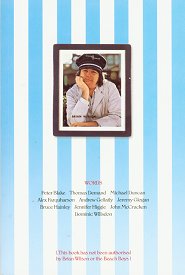
Brian Wilson: An
Art Book Edited by Alex
Farquharson; Four
Corners Press, 115 p.
"[Michael]
Moore's use of
"Wouldn't It
Be Nice"
[in the film
Roger & Me]
brings out
its sardonic
aspect.
It's a side to
the song that
gets stronger
the more you
listen to it,
and the older
you get.
The tinkly,
merry-go-round intro
sounds like
its preparing
us to
condescend to
whatever
follows. The
sentiment
"wouldn't it
be nice" seems
trivial,
"nice" being
such a vague
and babyish
adjective.
It is as if
the boy is
unable to
describe or
even feel the
specific
quality and
grain of the
emotional life
he is wishing
for... He can
only imagine
it as a
quantitative
change, or
more of what
he already has
- like wanting
more cake or
more pie.
...The song
seems to mock
the young
couple, or the
boy at
least.
It seems to
mock his
failure to
know himself
and grasp the
value of what
he already
has. It
makes his hope
seem
preposterous."
Domenic
Willsdon ~ pg.
36
Mike
Love would hate this
book. Not only does it
take Brian Wilson seriously,
it takes him waaaaaayy too
seriously for its own
good. That being said,
however, Brian Wilson: An
Art Book is an
interesting read, being a dual
collection of essays, musings,
and full-color photos of
artwork which the editor, Alex
Farquharson claims is
inspired, or at least in the
spirit of, the music of Brian
Wilson. Occasionally
light and frothy, but more
often heavy and intellectual,
the various authors take the
high road in their pursuit of
the meaning of Brian Wilson's
music, and, for the most part,
succeed in writing
entertaining,
thought-provoking
essays. Subject matter
includes a full-bore
dissection of "Wouldn't It Be
Nice" (quoted in the essay
above); a mini-biography on
Brian by Peter Blake (who
designed the artwork
for Brian's Gettin'
In
Over My Head album);
a
colorful description of Los
Angeles by Andrew Gellatly; a
line-by-line prose dissection
of "Guess I'm Dumb" by
Jennifer Higgie; a written
portrait of Brian Wilson
performing Pet Sounds
live by Thomas Demand; a brief
appreciation of "Good
Vibrations" by John McCracken;
a few treatises on "SMiLE;"
and much more besides.
The essays are, for the most
part, exercises in
intelligentia, with lots of
footnotes, and words that cost
significantly more than ten
dollars apiece. Not
exactly my cup of tea, but
never devolving into that kind
of scholarly self-parody which
fills modern
universities. The second
half of the book is where I
lament the small dimensions
chosen. Art needs to be
seen in large canvasses, and
the book, which is scarcely
larger than a trade
paperback, leaves the
pictures sorely
compressed. Art
appreciation not being my
strong suit, I shall suffice
to say that some of the 'art'
presented is directly linkable
to Brian Wilson/the Beach
Boys; some is loosely inspired
by their music; and several of
the pieces I see no connection
at all. I give kudos
anyway to the authors, artists
and editor for trying
something different, and in so
doing, creating a unique
tribute to Brian Wilson.
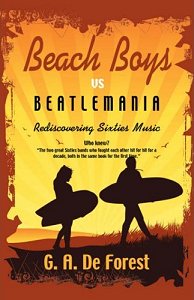
Beach Boys Vs.
Beatlemania:
Rediscovering Sixties
Music
G.A. De Forest;
Booklocker.com, Inc.,
448 p.
"Despite
[The Beatles] "Luv,
Luv, Luv" mantra,
nasty personal
politics emerged in
breakup as all burst
into song
unflattering to all
- tit for tat
attacks in unbounded
superstar
self-indulgence,
abusing their
exalted position to
demean their art
form. Yet
because the group
died violently in
its prime (and
resisted all pleas
for a rebirth) the
Princess Diana
Effect mummifies a
far-fetched pristine
image. There
is no question of
speaking ill of
their legacy, and an
objective
reappraisal of their
value will wait
until all media
contemporaries in
their thrall have
retired from the
airwaves.
While the Beatles
weren't responsible
for every loopy
gesture of fandom a
finger points at
them for hyping
it... Their
unbounded,
unconditional
success has a lot to
answer for in
foisting a travesty
on the musical
world, preventing a
genuinely new course
for modern popular
music. They
could be accused of
corrupting rock in
their own way as
much as the tame
Elvis lookalikes
they allegedly saved
rock 'n' roll from."
[pg. 137]
REVIEW: G.A. De Forest,
the author of Beach Boys
vs. Beatlemania,
has written a book that is
both fascinating and
frustrating. The
germ of his premise, that
The Beatles undeservedly
ripped away The Beach
Boys' rightful crown as
60s music gods, has been
endlessly debated in the
bands' various forums for
decades, and this
polarizing book regularly
succumbs to "fighting
words" in casting a blind
eye towards The Beach Boys
personal faults, while
pillorying The Beatles at
every opportunity.
Beatles fans: watch
out.
The author casts a wide
net, using his impressive
grasp of musical trends
and various genre's tidal
forces to knit together an
enlightening overview of
the era's rapidly-changing
soundscape. In this
regard, the book strongly
reminded me of the
similarly epochal Nearest
Faraway Place
by late author and editor
Timothy White, and in a
comparative degree, I
found it difficult to
navigate the numerous
side-roads onto which the
author swerves.
Often, a paragraph is so
stuffed with references to
other artists and singles
that it takes a visible
effort to leap back
to a chapter's original
premise. The author
also makes some strange
comparative leaps early on
- for instance, the odd
lambasting of The Osmonds
(?) who didn't appear on
the scene until a decade
after the appearance of
The Beach Boys.
The most damning aspect of
the book, however, is the
unrelenting bilious tone
adopted towards The
Beatles. The
author's transparent
campaign of leveraged,
personal attacks on their
character, backgrounds,
songwriting abilities, and
successes is unremitting
in its vehemence and
ferocity - it's made
perfectly clear that the
author believes The
Beatles to be no-talent
poseurs who owe all their
success to others.
And although the author
quotes several front-line
sources who appear to
agree with his assertions,
there are no opposing
viewpoints sought, or
given, and the sad end
result reads like a
semi-hysterical rant, or a
very bad case of sour
grapes.
As someone who grew up
loving The Beatles, but
ended up preferring The
Beach Boys, I understand
the feeling of being a fan
of an under-appreciated
band, but the book's
arguments would have been
better served if the
author had paired with a
knowledgeable Beatles
biographer to write the
alternating histories of
each band, which would
have lent the book a
semblance of
even-handedness.
That being said, Beach Boys vs.
Beatlemania is
worth picking for for the
author's panoramic view of
musical trends, and for
his often arresting
glimpses into pop music's
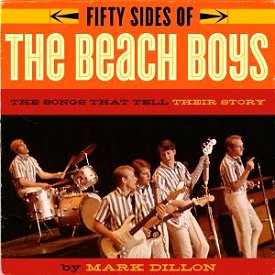
most volatile era. Fifty Sides Of
The Beach Boys: The
Songs That Tell Their
Story
by Mark
Dillon; ECW Press, 316
p.
Published June 1, 2012
Reflecting
on
the Beach Boys'
long, fascinating
history, this book
tells the story
behind 50 of the
band's greatest
songs from the
perspective of group
members,
collaborators,
fellow musicians,
and notable fans. It
is filled with new
interviews with
music legends such
as Brian Wilson,
Mike Love, Alan
Jardine, Bruce
Johnston, David
Marks, Blondie
Chaplin, Randy
Bachman, Roger
McGuinn, John
Sebastian, Lyle
Lovett, Alice
Cooper, and Al
Kooper, and
commentary from a
younger generation
such as Matthew
Sweet, Carnie
Wilson, Daniel
Lanois, Cameron
Crowe, and Zooey
Deschanel.
REVIEW:
This neat
little square book, about
the size of a 45 single, is
a fun read.
For music fans
who are just now discovering
The Beach Boys through the
interest generated by the
band's 50th Anniversary
tour, this book might be an
ideal introduction, for it
not only is a compact
introduction to fifty of The
Beach Boys most influential
songs, it also serves as an
short introduction to the
band members, and the
artists who their music
influenced. I went
into this book expecting
more of a musical biography,
since the Beach Boys have
used their music to a large
degree in revealing their
personal lives (i.e.; "I'm
Bugged At My Old Man" or
"Caroline, No") - but author
Mark Dillon instead has
pulled together a vast range
of interested others,
including musicians,
authors, and band members,
to discuss why certain songs
are important to them, or
how they impacted society at
large. So you might
have Alice Cooper on "In My
Room", and then jump to
Bruce Johnston, or Blondie
Chaplin, or Mike Love, or
Tony Asher, or Hal Blaine,
Roger McGuinn, etc., etc.
Fifty songs, fifty
different people. And
although each song receives
about a four-page
discussion, this isn't
really in-depth analysis of
the songs; in fact one of my
quibbles with the book is
how often the discussion
veers away from the songs
they're supposed to be
discussing, and instead
looks at the interviewee's
own life and career. Eh -
it's still interesting, but
if you're planning on
purchasing this book
expecting deep dissection of
either the Beach Boys or
their private lives, look
elsewhere. This is a
fun, sometimes surprising
look at the Beach Boys
catalog, with personal
tidbits strewn about, and
short anecdotal stories
woven throughout the
narrative. A very
enjoyable, quick read,
although I'm also miffed
that my own personal
favorite Beach Boys song
wasn't included. (if you
want to know, it's "You're
So Good To Me"); maybe
they'll be a Volume 2?
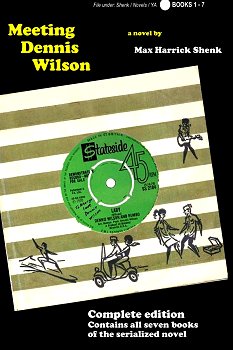
Meeting Dennis Wilson: A
Novel
by Max
Harrick Shenk;
CreateSpace
Independent
Publishing,
636p., Released
December 3, 2013
15
year old softball
pitcher (and Beach
Boys fan) Margo
LeDoux has a crush
on Beach Boys
drummer Dennis
Wilson, and wants
to meet him, but
her boyfriend,
Scott, doesn’t
really like the
idea (“I don’t
want you runnin’
off and bein’ some
groupie!”).
Meanwhile, Margo’s
best friend (and
our narrator)
Brian Pressley and
his girlfriend,
Christy Kelly,
decide that
they’re going to
“take steps”
toward going all
the way, steps
which seem to get
them into trouble
no matter how
careful they are.
And how can a girl
with a
rockstar-sized
crush meet the
drummer of her
dreams? This
LIMITED EDITION
complete volume
contains all of
the contents of
the seven
individual
serialized books
REVIEW: OK, this
one was just
weird. One of the
downfalls of modern
self-publishing is that
pretty much ANYONE can
put something in print,
without all the
bothersome business of
editors or common
sense. Max Shenk,
a twice-divorced
40-something 'author'
who lives in Vermont,
has written, in the
questionable tradition
of Glimpses
and Whale
Music, yet
another fictional story
of The Beach Boys, this
time using the band as a
backdrop for a story of
teenage crushes, losing
your viginity, high
school prom and love
triangles.
Originally serialized in
a seven-book(!) series,
this "limited-edition"
gathers all seven of
those books into one
torturous 650-page
monstronsity sure to
test the patience of all
but the most rabid
reader. Written
with all the panting
haste of a cut-rate
Harlequin novelist
merged in an unholy
union with oh, say, Judy
Blume, this novel
possesses a very strange
vibe. Any book
that begins with a
character clenching up
his butt cheeks when
asked if he's been in
a girl's bedroom
has pretty much lost me
from the word
"go". But hey, if
you can wrap your head
around the thought of a
forty-year-old man
writing in the first
person the character of
a teenage girl who's hot
and bothered over the
ideas of chasing after
Dennis Wilson of the
Beach Boys, then you're
a better(?) person than
I am, because I just
couldn't do it.
I'm sure that a
psychiatrist could make
a big deal out of the
author's intent, but I'm
simply not up to
it. I'm including
it on my site for the
sake of completeness,
but please, don't make
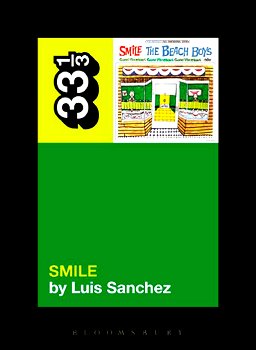
me read it again. 33-1/3:
Smile By Luis Sanchez Bloomsbury
Academic, 144 p., Released May 8,
2014
Description:
Smile is not
merely a great
unfinished album,
but a living work
of art that is all
at once expansive,
indeterminate, and
resolutely pop.
Looking to revise
and expand, Brian
Wilson sought
collaboration with
a brilliant
musician named Van
Dyke Parks.
Together they
began work on Smile,
an ambitious album
of music that
refracted The
Beach Boys’
naïveté into a
visionary
exploration of
American
consciousness.
Smile edged so
close to greatness
it seemed destined
to become one of
the most
significant
musical advances
of its time. But
the story didn't
end quite like
this.
In this book of
evocative essays,
Sanchez traces the
musical journey
that transformed
The Beach Boys
from West Coast
surf heroes into
America’s pop
luminaries, and
ultimately why
Smile represents a
tumultuous turning
point in the
history of popular
music.
REVIEW:
Bloomsbury
Publishing has made a nice
living with their "33-1/3"
series of books devoted to
examining rock albums, and
this volume (number 94 in
the series!) recruits
Texan PhD of Musicology
Luis Sanchez to tackle The
Beach Boys legendary
"lost" 1967 album, Smile.
Unfortunately, while Dr.
Sanchez has an
occasionally too-obvious
love and appreciation for
The Beach Boys, his
approach to this book is
off-target. Rather
than examine the album in
depth, and all its many
interwoven parts, (not to
mention its complex
history), the author
instead decided to take a
parenthetical tack,
weaving Smile into
the entire history of the
Beach Boys; the musical
movements and artists they
were influenced by, and
wrap it all up in a gushy,
hagiographic love
letter.
So,
instead of Smile,
you get everything around
it - with the odd opening
scene of a post-Smile
moment: Brian's infamous
appearance in the 1976
Saturday Night Live
"Surfing" sketch starring
Dan Ackroyd and Jim
Belushi. Then -
flashback - starting with
the Beach Boys first song,
and tying in Bob Dylan,
George Gerswhin, Brill
Buiding songwriters, and a
dollop of Phil Spector,
along with side-trips into
The Beach Boys
inter-relationships within
the band and
outside. We read
about the press build-up
of Brian as a genius, and
its sad aftermath, but
we're never taken into the
studio to see how Smile
happened, or given much of
a taste of the music
itself. Part of the
problem is the author's
lack of access to Brian
himself - outside of his
encounter with Van Dyke
Parks, most of the
author's sources are taken
from previously-published
works, so outside of the
author's own fawning
opinions, there's not much
new here for fans.
Reading this was like
standing outside the
recording studio and
straining to hear what's
going on inside - a
limited, frustrating
experience.
Sanchez admits in the
introduction that he
struggled with how to
approach the topic of Smile,
and relates that a
conversation with Van Dyke
Parks led him to this
final approach. But
it's a misguided one; fans
who love Smile and its
myth will find very little
of the album within these
pages, instead, we're
treated to a biographical
portrait filled with facts
borrowed from other,
better sources. A
missed opportunity. The
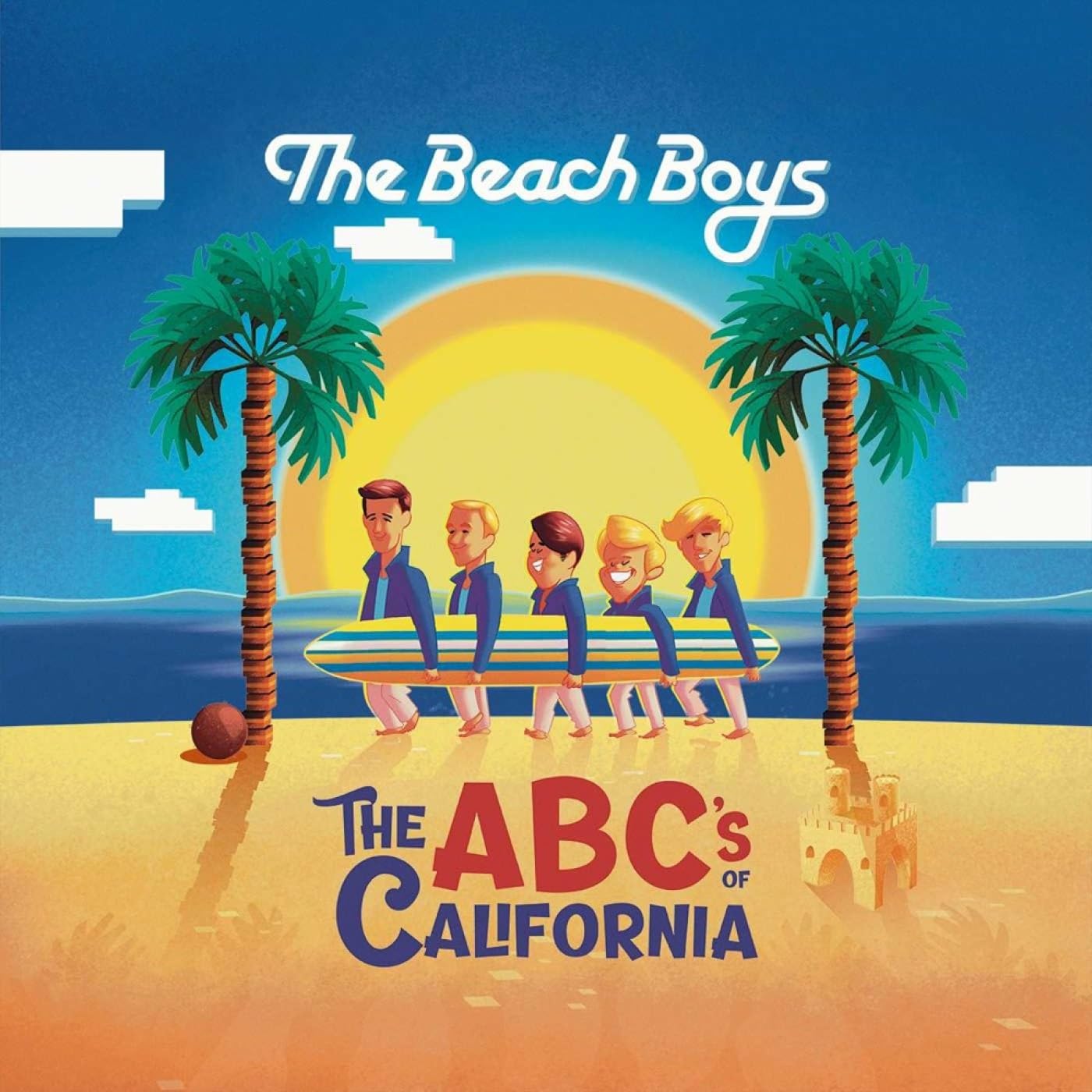
Beach Boys Present: The
ABC's of California Hardcover
– Picture Book, March 5,
2024 by David Calcano
(Author), Lindsay Lee
(Illustrator)
Join The
Beach Boys, Brian,
Mike, Al, Dennis and
Carl, on a musical
surfin’ adventure
across sunny
California, all
while learning the
ABCs through
beautifully
illustrated pages
that will both
entertain and
educate.
What better way to
teach your little
ones the alphabet
than by hanging out
with The Beach Boys
in sunny California!
This 60-page, full
color first official
Beach Boys
children’s book
takes you across the
entirety of
California, on a
musical and
educational
adventure. Each page
provides lessons
that teach useful
words, the landmarks
of California, and
the Beach Boys
REVIEW: So
it's come to this. The
Beach Boys, who my mother
considered counter-cultural
drivel compared to the smooth
50's pop groups she grew up
listening to, is now the
fodder of whatever Baby
Boomer Great Grandparents
want to give their
great-grandchildren to
introduce them to the music
of their childhood.
There have been biographies
of The Beach Boys aimed at
younger readers (mostly
teen), and of course there's
Al Jardine's picture book on
Sloop John B (reviewed above), but this is by far
the youngest demographic
ever attempted for the band
- a pre-Kindergarten
crowd. I think it's a
charming book - well done,
with brightly colored graphics
(by artist Lindsay Lee), characters
who look not unlike their 60's-era
counterparts, and each
letter of the alphabet tied
into either The Beach Boys
themselves, or California
culture at large. So
while the big five band
members are all represented
(with no mention of the
infighting, lawsuits, or
emotional baggage which are
part-and-parcel of their
legacy), along with
name-checked songs appropriate
to each letter of the
alphabet, which parents/guardians
can play for the readers
after perusing each
page. It's kind of
fun, utterly inoffensive,
and a perfect introduction
for little toddlers who
might light to bounce along
to "All Summer Long" or "Good
Vibrations."
 (out
of five)
(out
of five)

 "Anyone who
has bootlegs from the Smile
sessions knows that
there was some real
magic there and that
Brian really had
something going.
It was a special time
and he was a special
genius who knew what he
was doing. Yes,
his vision got shaken up
at the end of the
sessions and he lost his
focus a bit but when he
was in control of
things, the music was
out of this world.
The Beach Boys versions
of those songs from the
Smile sessions on
the Smiley Smile
album are
very disappointing
and even they knew that
they had fallen short on
the project." [pg.
72]
"Anyone who
has bootlegs from the Smile
sessions knows that
there was some real
magic there and that
Brian really had
something going.
It was a special time
and he was a special
genius who knew what he
was doing. Yes,
his vision got shaken up
at the end of the
sessions and he lost his
focus a bit but when he
was in control of
things, the music was
out of this world.
The Beach Boys versions
of those songs from the
Smile sessions on
the Smiley Smile
album are
very disappointing
and even they knew that
they had fallen short on
the project." [pg.
72]